Learn how to choose the right PA system for your business in Malaysia. Compare speakers, microphones, amplifiers, and key installation considerations.
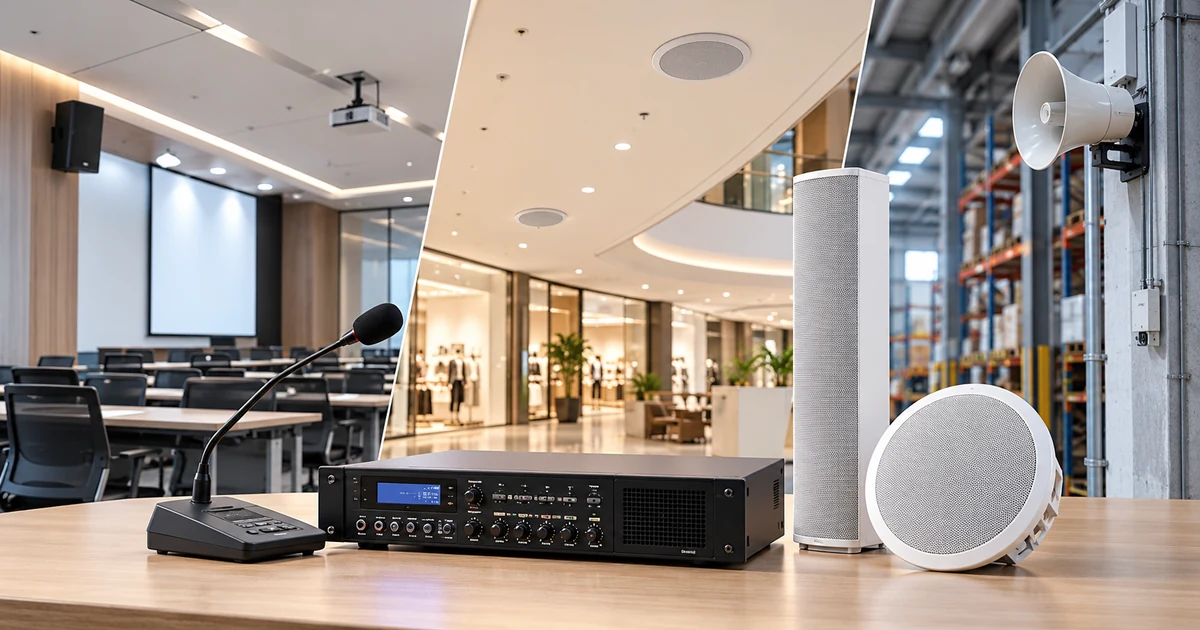
Selecting the right public address system is one of the most critical infrastructure decisions for any business, commercial facility, or public venue. Whether you operate a corporate office in Kuala Lumpur, manage a manufacturing plant in Selangor, oversee an educational campus in Penang, or run a retail showroom in Johor Bahru, reliable audio communication ensures clear announcements, background music delivery, and prompt emergency notification.
Investing in a commercial audio system requires more than simply buying a set of speakers and a microphone. Factors such as room acoustics, power matching, speaker distribution, and ambient noise levels dictate system performance. This guide breaks down everything you need to know when evaluating a PA system in Malaysia, helping you select equipment that delivers intelligible sound, durable performance, and long-term value.
Before reviewing equipment specifications, define the primary function of your audio setup. Most commercial sound installations fall into three functional categories:
Voice Paging and Emergency Announcements: Speech intelligibility is paramount for warehouses, healthcare centers, transport hubs, and office buildings. These setups prioritize crisp vocal clarity and uniform volume distribution across distinct zones rather than deep bass response.
Background Music (BGM): Cafes, restaurants, boutique retail stores, and hotel lobbies require balanced, unobtrusive audio with full-range frequency reproduction. The goal is to enhance customer atmosphere without overpowering conversation.
Multi-Purpose & Performance Audio: School halls, conference rooms, auditoriums, and event spaces demand high dynamic range, multiple microphone inputs, and sufficient acoustic output to handle both live speaking presentations and musical performances.
For custom configurations tailored to specific operational environments, explore our specialized audio visual solutions to see how enterprise sound packages are designed across various sectors.
Proper sound coverage means listeners hear announcements clearly regardless of where they stand or sit within your facility. High ceilings, reflective hard surfaces, and ambient machinery noise all impact acoustic performance.
In high-noise environments like factories and logistics warehouses, high-efficiency horn speakers cut through background chatter. Conversely, enclosed corporate meeting rooms with carpet and acoustic panels require low-distortion cabinet or flush-mount ceiling speakers to maintain a professional, comfortable listening experience.
Choosing the correct speaker form factor depends on architectural constraints, ceiling heights, and room aesthetics:
Ceiling speakers install flush into false ceiling plasterboards or acoustic ceiling tiles, making them nearly invisible. They provide wide, downward conical dispersion, making them ideal for uniform coverage in offices, retail outlets, banks, and hospital corridors. In high-ceiling open spaces, pendant-style drop-down speakers offer an elegant alternative that brings sound closer to ear level.
When ceilings are solid concrete, unusually high, or inaccessible, surface-mount wall speakers are the standard choice. Column speakers, in particular, feature vertical speaker arrays that concentrate audio dispersion horizontally while minimizing vertical reflections from ceilings and floors. This makes them highly effective in reverberant venues such as houses of worship, multi-purpose halls, and open cafeterias.
Not every organization requires fixed cabling. If your organization hosts roadshows, weekly outdoor sports events, training workshops, or pop-up retail activities, an all-in-one mobile sound solution is far more practical. Explore our dedicated portable PA systems featuring built-in rechargeable batteries, integrated wireless receivers, and Bluetooth media playback.
Understanding the distinction between active and passive speaker configurations helps clarify your hardware and cabling needs:
Active (Powered) Speakers: Feature built-in internal amplifiers and connect directly to line-level sound sources or mixers. They are simple to deploy for small venues, portable setups, and active monitoring, though each speaker requires both audio signal and electrical power cabling.
Passive Speakers & 70V/100V Line Systems: In commercial sound systems spanning multiple rooms or large floorplates, passive speakers connected to high-voltage constant voltage distribution lines (commonly 70V or 100V in Malaysia) are the industry standard. High-voltage lines allow dozens of tapped speakers to run over long cable distances with minimal signal loss and without individual power outlets at each speaker location.
The amplifier is the core engine of your public address infrastructure. Choosing the right unit involves balancing power output, input flexibility, and zoning capabilities.
Mixer Amplifiers: Combine an audio mixer and a power amplifier into a compact chassis. They accept multiple inputs (microphones, media players, auxiliary devices) and provide master volume, tone adjustments, and priority muting for urgent announcements.
Multi-Zone Paging: Commercial facilities frequently require independent volume control and selective paging across different departments—such as broadcasting announcements solely to the warehouse without interrupting client discussions in the showroom.
Calculating Power Headroom: When sizing a 100V line amplifier, sum the wattage taps of all connected speakers and add a 20% to 30% headroom buffer. For example, driving ten speakers tapped at 6 Watts each (60W total load) requires an amplifier rated for at least 80W to 100W to prevent thermal overload and signal clipping. Browse our complete range of commercial mixer amplifiers in the products catalog.
A sound system is only as clear as its input source. Selecting suitable microphones depends on user mobility and application:
Paging Microphones: Desktop gooseneck microphones equipped with push-to-talk buttons and chime triggers are engineered for reception counters, security control desks, and administrative offices.
Wireless Handheld, Lavalier & Headset Systems: Indispensable for presenters, fitness instructors, and meeting facilitators who move freely. Ensure wireless systems operate within regulatory spectrum frequencies permitted in Malaysia (such as approved UHF or digital 2.4GHz bands) to avoid radio interference.
Professional PA system installation involves proper structural mounting, organized equipment rack dressing, balanced signal wiring, and protective grounding. High-quality fire-resistant and oxygen-free copper speaker cabling safeguards signal integrity against hums and electromagnetic interference caused by nearby lighting circuits and air-conditioning units.
Always plan for future growth. Choosing an amplifier with spare channel capacity or expansion ports ensures you can add extra zones or speakers when your business expands without replacing your entire head-end equipment. Check out our dedicated PA systems category for end-to-end commercial setups.
While basic consumer sound equipment may appear cost-effective initially, consumer audio gear is not engineered for 24/7 continuous duty cycles. Commercial public address equipment incorporates heavy-duty toroidal transformers, thermal protection, and industrial heat sinking designed for round-the-clock reliability. Investing in purpose-built commercial equipment prevents costly downtime and premature hardware replacement.
A public address (PA) system focuses primarily on voice amplification, speech intelligibility, and background audio distribution across indoor or outdoor zones. An audio visual (AV) system combines commercial sound with visual displays, video projectors, interactive screens, and integrated control automation.
Yes. Commercial mixer amplifiers feature priority ducking or automatic muting. When an announcement microphone is activated, the background music automatically attenuates or mutes, returning smoothly to normal playback once the speech finishes.
As a rule of thumb for standard ceiling heights between 2.8m and 3.2m, spacing ceiling speakers approximately 4 to 6 meters apart provides smooth, overlapping sound coverage without dead spots or excessive volume hotspots.
A well-engineered public address system enhances daily operational workflow, elevates customer experience, and ensures facility safety during emergencies. By carefully assessing your space, selecting compatible commercial components, and ensuring professional installation, you establish sound communication you can rely on for years to come.
Looking for professional advice on designing or upgrading a public address system in Malaysia? Explore our comprehensive PA systems and full audio visual solutions, or contact the technical specialists at Vbizz for equipment specifications, system sizing, and quotation support.